Segovia at a Gentle Pace: Easy Routes and Restful Spots for Older Travellers
 Segovia at a Gentle Pace: Easy Routes and Restful Spots for Older Travellers
Segovia's old town is built on a hill, but with the right plan you can see the Aqueduct, Alcázar and cathedral without exhausting yourself — here's how to pace it, where to pause, and where to stay.
Arriving and Getting Your Bearings
Segovia is compact, but its historic centre sits on a ridge between the Eresma and Clamores valleys, so flat walks are rare. The high-speed train from Madrid arrives at Segovia Guiomar station, 6 km northwest of the centre; a taxi to Plaza del Azoguejo takes about 12 minutes and costs roughly €10–12. If you come by bus from Madrid's Moncloa, you arrive at the bus station on Paseo de Ezequiel González, a 10-minute walk from the Aqueduct. For older travellers, the train plus taxi is the least tiring combination. Avoid the regional train to Segovia's old station, which leaves you 2 km from the centre, and skip the idea of walking from Guiomar — the road is unlit in parts and not pedestrian-friendly.
Once in town, the Aqueduct is your landmark. Plaza del Azoguejo, beneath the arches, is the lowest point of the old town, and everything else climbs from there. The tourist office on Calle del Cronista Lecea (just off Plaza Mayor) has free maps and can tell you which streets are stepped. Buses 1, 2 and 3 connect the Aqueduct area with the bus station and the hospital, but for most gentle sightseeing you will walk — just plan downhill routes. A useful rule: start high, end low. Take a taxi up to the Alcázar or Plaza Mayor in the morning, then wander downhill back to your hotel.
The Classic Sights Without the Climb
The Aqueduct itself needs no ticket and is best seen from Plaza del Azoguejo, where the arches are tallest. From there, Calle Real leads uphill to Plaza Mayor; it is pedestrianised but cobbled and gently sloping for about 400 metres. If that feels like too much, the small tourist train (departing from Plaza del Azoguejo) does a 45-minute loop past the Aqueduct, Alcázar and San Millán church without any walking. It runs daily from about 10:30 to 19:00 in summer, less frequently in winter; tickets cost around €5–6. I would take it on the first morning to get oriented, then decide which sights deserve a closer look.
The Alcázar is the highlight for many visitors, but its interior involves narrow spiral staircases and uneven floors. The courtyard and exterior are flat and free to enter, and the views from the surrounding gardens are excellent. Inside, the Chapel and Hall of Kings are step-free, but the Tower of Juan II requires climbing 152 steps — skip it if knees are a concern. The cathedral, on Plaza Mayor, is entirely on one level with seats in the nave, and entry is about €4. The Jewish quarter around Calle Judería Vieja is atmospheric but steep and cobbled; visit in the morning when it is quiet, and wear shoes with grip.
Places to Rest and Refuel
Segovia's café culture is your best friend. Plaza Mayor has several terraces with waiter service and shade; a coffee costs €1.50–2.50, and you can sit for as long as you like. For a proper sit-down lunch, the side streets off Plaza Mayor (Calle Infanta Isabel, Calle Isabel la Católica) have restaurants with menús del día at €15–20, usually including a starter, main and dessert. Avoid the places with photo menus right on the aqueduct square — they are pricier and rushed. If you need a quiet bench, the Jardines de la Merced, next to the cathedral, are shaded and rarely crowded, and the Plazuela de San Martín has benches under the arcades.
For a longer rest, the Casa de la Química on Calle San Agustín is a small cultural centre with a courtyard and toilets, free to enter. The Esteban Vicente museum on Plaza de las Bellas Artes has a lift, seating and a peaceful garden. In the afternoons, when tour groups thin out, the area around the Convento de San Antonio el Real (a 15-minute walk from the Aqueduct, mostly flat) is calm and green. Best months for gentle weather are May, June and September; July and August afternoons regularly hit 35°C, so plan indoor visits or a siesta between 14:00 and 17:00.
Where to Stay and What to Skip
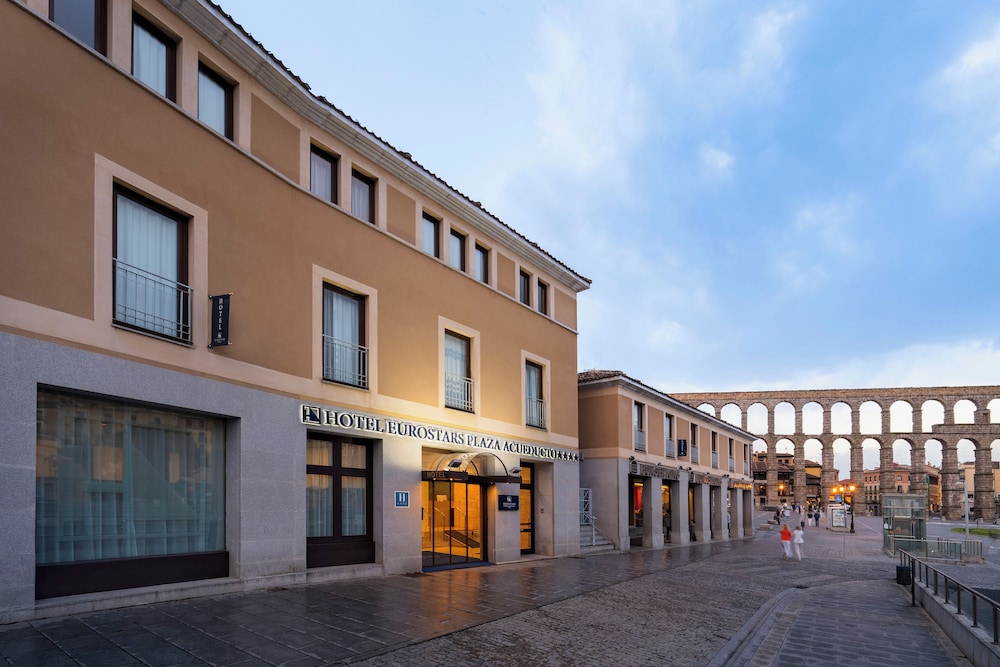
For older travellers, I would book a hotel on or near Plaza Mayor or along Calle Real. You are within 300 metres of the cathedral, the Alcázar entrance and the main taxi rank, and the slope back up from the Aqueduct is gradual if you take Calle Real rather than the stepped side streets. Expect to pay €70–120 for a double room in a mid-range hotel in spring or autumn; prices rise in July and during the Fiesta de San Frutos (25 October). Hotels near the Aqueduct are convenient for arrival but noisier, and the area around the bus station is practical but lacks atmosphere. Avoid staying outside the old town unless you have a car — taxis are cheap but scarce at night.
Skip the full circuit of the city walls (walking the entire perimeter is uneven and unshaded) and the climb to the Torreón de Lozoya viewpoint if you have mobility concerns. The suggested route for a gentle day: taxi to the Alcázar for the gardens and chapel, walk downhill to Plaza Mayor for a coffee, then continue down Calle Real to the Aqueduct for photos. That is under 1.5 km with plenty of benches. For dinner, choose a restaurant with tables on the ground floor and avoid the steep basement dining rooms common in the old town.
Before you book
The questions people ask about Segovia, answered with this month’s numbers.
Yes, with planning. Use taxis for uphill stretches (€6–8 within the centre), stick to Plaza Mayor and the Aqueduct area, and take the tourist train to see the wider sights. The Alcázar courtyard and cathedral are step-free.
May, June and September offer mild temperatures and manageable crowds. July and August can be very hot, while winter mornings are cold but often sunny. Spring and autumn are ideal for gentle walking.
Choose a hotel on or near Plaza Mayor, such as along Calle Real or Calle Isabel la Católica. This puts you close to the cathedral, Alcázar and taxi ranks, with a gradual downhill walk to the Aqueduct.